Membrane modules for nitrogen and oxygen generators
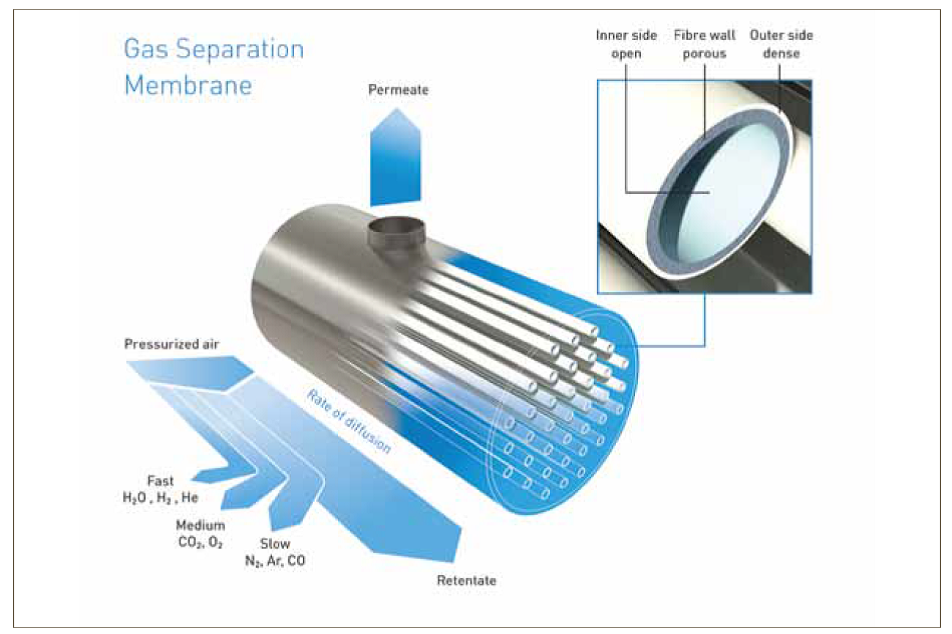
Membrane technology uses bundles of hollow fibers installed in the tube. Nitrogen is selectively separated from nitrogen on the fiber walls (retentate or superconcentrate) an oxygen-saturated air (filtrate and permeate).
Membrane modules of Fluxx type (HiFluxx® and SmartFluxx®) are designed to produce nitrogen with purity from 95% to 99,9%.
Membrane modules of Oxy types (EnOxy®) are designed to produce oxygen-saturated air, in concentration from 28% to 40%
Systems based on Parker membrane modules work within air inlet pressure range from 4 to 13 barG.
The higher air inlet pressure is, the greater volume of nitrogen and oxygen-saturated air can be produced per fiber unit. Using of compressed air is one of the key factors influencing the cost of generated nitrogen.
An optimal pressure for industry is 7-8 barG, and exactly within such pressure range Parker membrane modules prove itself as the most efficient solution. For each 1 bar of pressure, required in the course of nitrogen generation, operational costs increase for 7% due to energy consumed by the compressor.
The smaller membrane diameter produces the higher risk of its clogging caused by pure air quality/presence of foreign particles. Parker membranes have the largest diameter; therefor they are much less sensitive to contaminations.
High pressure drop is one more implication caused by small membrane diameter. Pressure drop involves excess energy demand, and Parker membrane modules are marked by the lowest pressure drop as compared to other analogues.
As soon as the modules are produced, molecules of plastics in the structure of the membrane are inevitably subjected to shrinkage. In the results shrinkage will obviously cause a lower membrane performance. Fibers of Parker membrane modules undergo artificial ageing procedure in the course of its production, that’s why Parker modules are not subject to performance degradation within the time.